Travel photography is more than simply clicking pictures of beautiful locations. It is about capturing emotions, culture, landscapes, and unforgettable experiences in a way that tells a meaningful story. Improving travel photography skills requires creativity, technical knowledge, observation, and regular practice. Whether you use a smartphone camera or a professional DSLR, understanding photography basics can help you capture more attractive and memorable travel photos.
A great travel photograph does not only show where you have been; it allows viewers to feel the atmosphere of that place. By learning camera techniques, improving composition, understanding lighting, and developing a storytelling approach, anyone can become a better travel photographer.
Understand Your Camera and Photography Equipment
The first step to improving travel photography skills is learning how to use your camera properly. Many beginners believe that expensive equipment automatically creates better photos, but the photographer’s knowledge and creativity are more important than the camera itself.
Understanding basic camera settings such as shutter speed, aperture, ISO, focus modes, and white balance helps you control how your images look in different situations. For example, shutter speed helps capture moving subjects clearly, while aperture controls the amount of background blur in a photo.
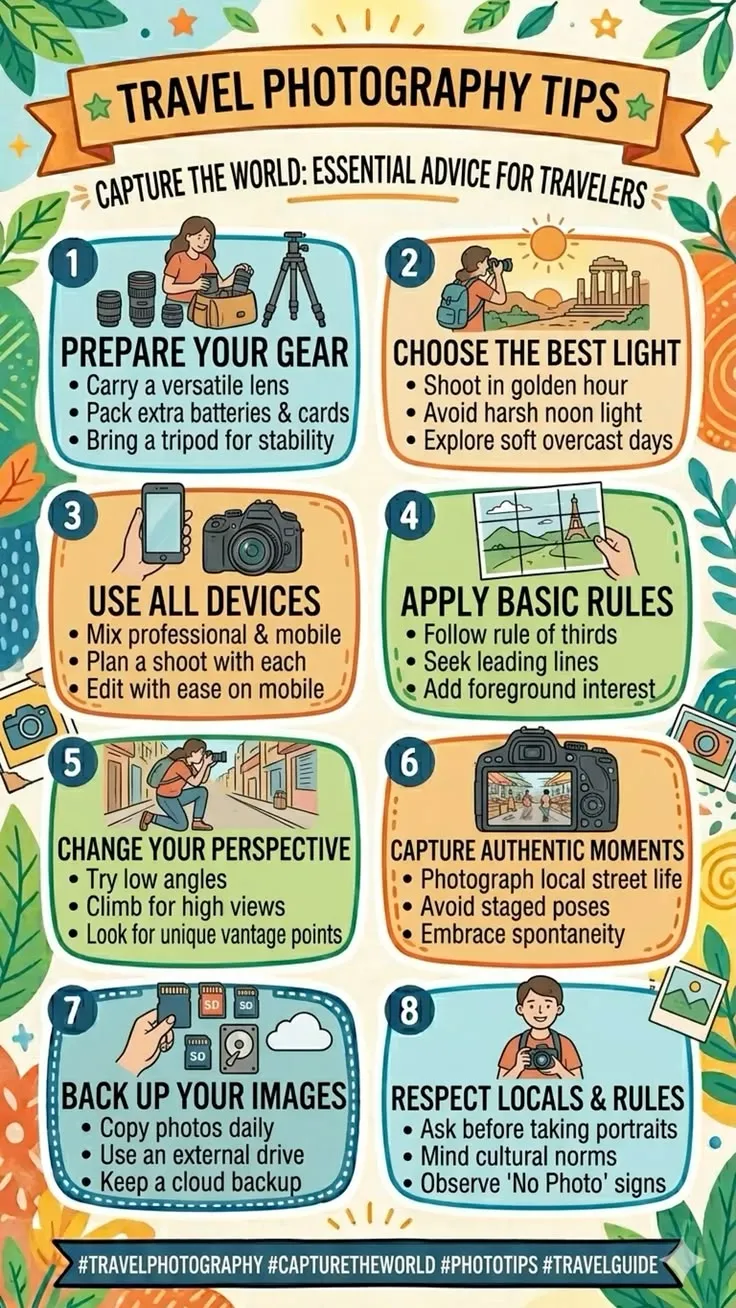
For smartphone users, learning manual camera features can also improve results. Modern smartphones offer advanced photography settings that allow users to adjust exposure, focus, and lighting conditions. Carrying useful accessories like extra batteries, memory cards, and a lightweight tripod can also make travel photography easier and more convenient.
Learn the Importance of Composition
Composition is one of the most important elements of photography because it determines how different parts of an image are arranged. A well-composed photo naturally attracts attention and creates a balanced visual experience.
One popular composition technique is the rule of thirds, where the image is divided into imaginary sections, and the main subject is placed at important points within the frame. This creates a more natural and visually pleasing photograph.
Another useful technique is using leading lines. Roads, bridges, rivers, and pathways can guide the viewer’s eyes toward the main subject and add depth to the image. Similarly, natural frames such as windows, trees, or architectural structures can make photographs more interesting by creating layers and focus.
Good composition helps transform ordinary travel scenes into powerful visual stories.
Master the Use of Natural Light
Lighting plays a major role in determining the quality of a photograph. Even a beautiful destination can appear less attractive if the lighting is not used correctly. Professional photographers often prefer natural light because it creates realistic and emotional images.
The golden hour, which occurs shortly after sunrise and before sunset, is considered one of the best times for photography. During this period, sunlight is softer and warmer, creating beautiful colors and gentle shadows.
Understanding light direction is also important. Taking photos with sunlight behind the subject can create silhouettes, while side lighting can add texture and depth. Avoiding extremely harsh midday sunlight can help prevent overexposed and flat-looking images.
By learning how light changes throughout the day, photographers can capture more professional-looking travel photos.
Focus on Storytelling Through Photography
The best travel photographs are not just attractive; they tell a story. Instead of only capturing famous landmarks, try to photograph the emotions, traditions, and everyday life of a destination.
A picture of a historical monument becomes more meaningful when it includes local people, cultural activities, or surrounding details. Images of street markets, traditional food preparation, festivals, and local lifestyles often represent the true character of a place.
Travel photography becomes powerful when it captures authentic moments. Observing your surroundings carefully and waiting for the right moment can help create images that connect emotionally with viewers.
Experiment with Different Photography Angles
Changing your perspective can make a simple photograph look unique. Many travelers take pictures from the same eye-level position, which can sometimes make images look ordinary.
Trying different angles allows photographers to present familiar places in new ways. Shooting from a lower angle can make buildings or objects appear more impressive, while capturing reflections in water or glass can add creativity to an image.
Photographers should also experiment with close-up shots, wide landscape views, and detailed images of small objects. Different perspectives help create a diverse collection of travel photographs.
Practice Regularly to Improve Photography Skills
Like any creative skill, photography improves with continuous practice. The more often you take photographs, the better you become at recognizing interesting subjects and capturing special moments.
Practicing different photography styles helps you understand what works best for your personal approach. Taking multiple photographs of the same location at different times can teach you how lighting and surroundings affect image quality.
Reviewing your own photographs is also important. By analyzing your images, you can identify mistakes and understand areas where improvement is needed.
Regular practice builds confidence and helps photographers develop their own unique style.
Learn Basic Photo Editing Techniques
Editing is an important part of modern photography, but it should be used carefully. Good editing improves the quality of an image while maintaining its natural appearance.
Basic adjustments such as improving brightness, correcting colors, increasing contrast, and removing small distractions can make travel photos look better. Cropping can also improve composition by removing unnecessary elements.
However, excessive editing can make photographs appear unrealistic. The purpose of editing should be to enhance the original image rather than completely change its natural beauty.
Capture Local Culture and Real Experiences
Travel photography becomes more meaningful when it represents the real identity of a destination. While famous tourist attractions are worth photographing, local experiences often create more memorable images.
Capturing traditional activities, local markets, regional food, and daily routines provides a deeper understanding of a place. These photographs preserve cultural memories and show aspects of travel that many visitors may overlook.
When photographing people, it is important to respect local traditions and privacy. Building a connection with people before taking their photographs often results in more natural and genuine images.
Plan Before Starting Travel Photography
Preparation can improve the quality of travel photographs. Before visiting a destination, learning about important locations, weather conditions, and the best times for photography can help capture better images.
Knowing when a location receives the best natural light allows photographers to plan their visits effectively. Understanding seasonal changes can also help capture destinations at their most beautiful moments.
However, photographers should also remain open to unexpected opportunities. Some of the best travel photographs happen during spontaneous moments that cannot be planned.
Avoid Common Travel Photography Mistakes
Many beginners make simple mistakes that reduce the quality of their travel photos. Taking too many similar images without a clear purpose can make it difficult to select the best shots.
Ignoring lighting conditions, using unnecessary filters, forgetting to clean the camera lens, and focusing only on popular tourist places are common problems. Paying attention to details and practicing proper techniques can help avoid these mistakes.
Learning from previous photographs is one of the fastest ways to improve photography skills.
Conclusion
Improving travel photography skills requires a combination of technical knowledge, creativity, patience, and practice. A successful travel photograph is not only about capturing a beautiful location but also about preserving emotions, stories, and experiences.
By understanding camera settings, improving composition, using natural light effectively, exploring different perspectives, and developing a storytelling approach, travelers can create stunning photographs that represent their journeys.
Whether you are using a smartphone or a professional camera, the most important factor is your ability to observe and capture meaningful moments. With continuous learning and practice, every journey can become an opportunity to create unforgettable travel memories.